Mahoning County, Ohio Property Tax Rates (2026 Guide by City & School District)
 Posted On
Property tax rates in Mahoning County, Ohio depend on your city, township, and school district. Ohio calculates property taxes on 35% of market value, with rates shown in mills.
For 2026, most residential tax rates in Mahoning County generally range from 42 to 60+ mills, while commercial rates are typically higher. School districts make up the largest portion of property taxes, so rates can vary even within the same city.
Knowing your exact district rate helps homeowners, investors, and business owners estimate taxes accurately and plan property decisions with confidence.
Mahoning County Property Tax Rates
These initial tax districts in Mahoning County include a combination of township-only areas and regions linked to incorporated cities or villages. Millage rates across these districts range from moderate to higher levels, influenced by local school district funding, municipal or village levies, and voter-approved service taxes. Residential and commercial property rates often differ noticeably, especially in areas with expanded public services or additional operating levies.
Mahoning County Tax Rates (Part 1: Areas 01–11)
This section covers the first eleven tax districts in Mahoning County, Ohio, including a mix of township-only areas and regions connected to cities or villages. Tax rates in these districts range from moderate to slightly higher levels, depending on school district levies, municipal funding, and local service needs. Residential and commercial millage rates may vary noticeably, especially in districts with additional operating or infrastructure levies.
| Area / Tax District | Residential Rate (mills) | Commercial Rate (mills) |
|---|---|---|
| 01 – Austintown Twp – Austintown LSD | 53.282 | 68.967 |
| 02 – Austintown Twp – Weathersfield LSD | 59.683 | 70.654 |
| 03 – Beaver Twp – Boardman LSD | 55.880 | 67.852 |
| 04 – Beaver Twp – Canfield LSD | 50.160 | 61.409 |
| 05 – Beaver Twp – Columbiana EVSD | 48.398 | 52.857 |
| 06 – Beaver Twp – Columbiana City EVSD | 51.679 | 56.931 |
| 07 – Fairfield Twp – Columbiana City – EVSD | 42.492 | 45.806 |
| 08 – Beaver Twp – South Range LSD | 55.484 | 60.533 |
| 09 – Berlin Twp – Western Reserve LSD | 52.066 | 55.397 |
| 10 – Boardman Twp – Boardman LSD | 54.450 | 67.132 |
| 11 – Boardman Twp – Canfield LSD | 48.730 | 60.688 |
Here’s a quick, organized look at the next set of tax districts in Mahoning County, Ohio for Tax Year 2025 (Calendar Year 2026) residential and commercial effective millage rates shown below are based on the official Mahoning County Auditor tax rate schedule.
These districts cover a mix of townships, villages, and school district combinations, and millage rates vary depending on local levies, school funding, and service needs. Residential and commercial rates typically differ, especially where additional services or operating levies apply.
| Area / Tax District | Residential Rate (mills) | Commercial Rate (mills) |
|---|---|---|
| 12 – Canfield Twp – Canfield LSD | 44.879 | 55.035 |
| 13 – Canfield Twp – Boardman LSD | 50.599 | 61.478 |
| 14 – Canfield City – Canfield LSD | 47.544 | 58.612 |
| 15 – Canfield Twp – Canfield City SD | 47.576 | 58.668 |
| 16 – Coitsville Twp – Campbell CSD | 59.367 | 67.276 |
| 17 – Coitsville Twp – Hubbard LSD | 63.172 | 73.477 |
| 18 – Coitsville Twp – Lowellville LSD | 53.221 | 71.070 |
| 19 – Coitsville Twp – Struthers CSD | 55.604 | 78.021 |
| 20 – Coitsville Twp – Youngstown CSD | 60.782 | 83.382 |
| 21 – Ellsworth Twp – Canfield LSD | 45.765 | 55.054 |
| 22 – Ellsworth Twp – Jackson‑Milton LSD | 49.327 | 52.672 |
Mahoning County Tax Rates (Part 3: Areas 23–33)
These tax districts include combinations of townships, villages, and school districts within Mahoning County. Effective millage rates vary by local levies and service needs, with commercial rates typically higher than residential in many areas.
| Area / Tax District | Residential Rate (mills) | Commercial Rate (mills) |
|---|---|---|
| 23 – Ellsworth Twp – Western Reserve LSD | 52.066380 | 55.396817 |
| 24 – Ellsworth Twp – Jackson‑Milton LSD | 49.327013 | 52.671836 |
| 25 – Ellsworth Twp – Canfield LSD | 45.764855 | 55.053575 |
| 26 – Canfield Twp – Canfield LSD | 44.878958 | 55.034962 |
| 27 – Canfield Twp – Boardman LSD | 50.598765 | 61.478493 |
| 28 – Canfield City – Canfield LSD | 47.543540 | 58.611706 |
| 29 – Boardman Twp – Boardman LSD | 54.450345 | 67.132198 |
| 30 – Boardman Twp – Poland LSD | 55.837239 | 61.756198 |
| 31 – Boardman Twp – Youngstown CSD | 54.487112 | 75.449614 |
| 32 – Boardman Twp – Canfield LSD | 48.729867 | 60.687597 |
| 33 – Craig Beach Village – Jackson‑Milton LSD | 49.327013 | 52.671836 |
For example:
District: Ellsworth Twp – Western Reserve LSD
- Residential rate: 52.066 mills
- Commercial rate: 55.397 mills
Assessed Value: 35% of market value
- Residential $200,000 → $70,000
- Commercial $300,000 → $105,000
Tax Calculation: (Assessed ÷ 1,000) × Millage
- Residential: 70 × 52.066 ≈ $3,645
- Commercial: 105 × 55.397 ≈ $5,817
This method works for any Mahoning County district just use the district’s millage and your property’s assessed value.
Major Cities in Mahoning County (2026 Property Tax Rates)
In Mahoning County, Ohio, property tax rates differ across major cities due to variations in local levies, school districts, and municipal services. While rates are calculated at the local level via city and school district millage, typical effective property tax burdens can be expressed as a percentage of assessed value.
Below are approximate median property tax rate ranges seen across key communities in Mahoning County these figures reflect local variations and are useful for quick comparison:
- Youngstown – ~1.76% to 1.80% of property value
- Boardman – ~1.78% to 1.79%
- Austintown – ~1.97%
- Canfield – ~1.62%
- Poland – ~1.92%
- Lowellville – ~1.76%
- Hubbard – ~2.15%
- Campbell – ~1.88%
- Berlin Center – ~1.87%
- Lake Milton – ~1.67%
- Struthers – ~1.49%
- Sebring – ~1.48%
Townships in Mahoning County
Mahoning County is divided into 14 townships, each with its own local government, property tax levies, and school district assignments. Townships manage local services such as road maintenance, zoning, and emergency services, which influence property tax rates in the area.
- Austintown Township
- Beaver Township
- Boardman Township
- Berlin Township
- Canfield Township
- Coitsville Township
- Ellsworth Township
- Green Township
- Jackson Township
- Lords Township
- Mahoning Township
- Milton Township
- Poland Township
- Smith Township
School District Linked Tax Areas
In Mahoning County, property taxes depend largely on school district boundaries. Even homes in the same township can have different tax rates if they belong to different districts.
Key Points
- School districts are the largest portion of property taxes.
- Residential and commercial rates may differ within the same district.
- Voter-approved levies affect total tax rates.
Major School Districts
- Boardman LSD
- Canfield LSD
- Austintown LSD
- Youngstown CSD
- Poland LSD
- Columbiana EVSD
Knowing your school district helps estimate taxes accurately and plan finances confidently.
How Mahoning County Property Tax is Calculated
Ohio uses a two-step valuation system:
- Appraised Value (Market Value) – The estimated fair market value of the property.
- Assessed Value = 35% of Appraised Value
Property Tax Formula: Property Tax=Assessed Value×Total Millage Rate÷1,000
In Mahoning County, Ohio, property taxes are calculated using a straightforward formula:
- Determine Market Value: The current fair market value of the property.
- Calculate Assessed Value: Ohio taxes only 35% of the market value.
- Apply Millage Rate: Multiply the assessed value by the total effective millage rate (includes school district, township, and city/village levies). Property Tax=(Assessed Value÷1,000)×Millage Rate
Example:
- Market value: $200,000
- Assessed value: 200,000 × 35% = $70,000
- Millage rate: 52.066 mills → 70 × 52.066 ≈ $3,645 annual tax
Mahoning County property taxes include:
- School District Taxes – Fund local schools.
- City/Township Taxes – Support roads, police, fire, and local services.
- County Taxes – Fund courts, health, and county operations.
- Voter-Approved Levies – Additional funding for schools, safety, or infrastructure.
Rates vary by district, township, and property type.
How to Pay Mahoning County Property Taxes
Paying property taxes in Mahoning County, Ohio is simple and convenient:
1. Online
- Visit the Mahoning County Auditor or Treasurer website to pay by credit/debit card or e-check.
2. By Mail
- Send a check or money order to the Mahoning County Treasurer’s Office with your tax bill stub.
3. In Person
- Visit the Treasurer’s Office during business hours to pay by cash, check, or card.
4. Bank Payments
- Some local banks offer property tax payment services.
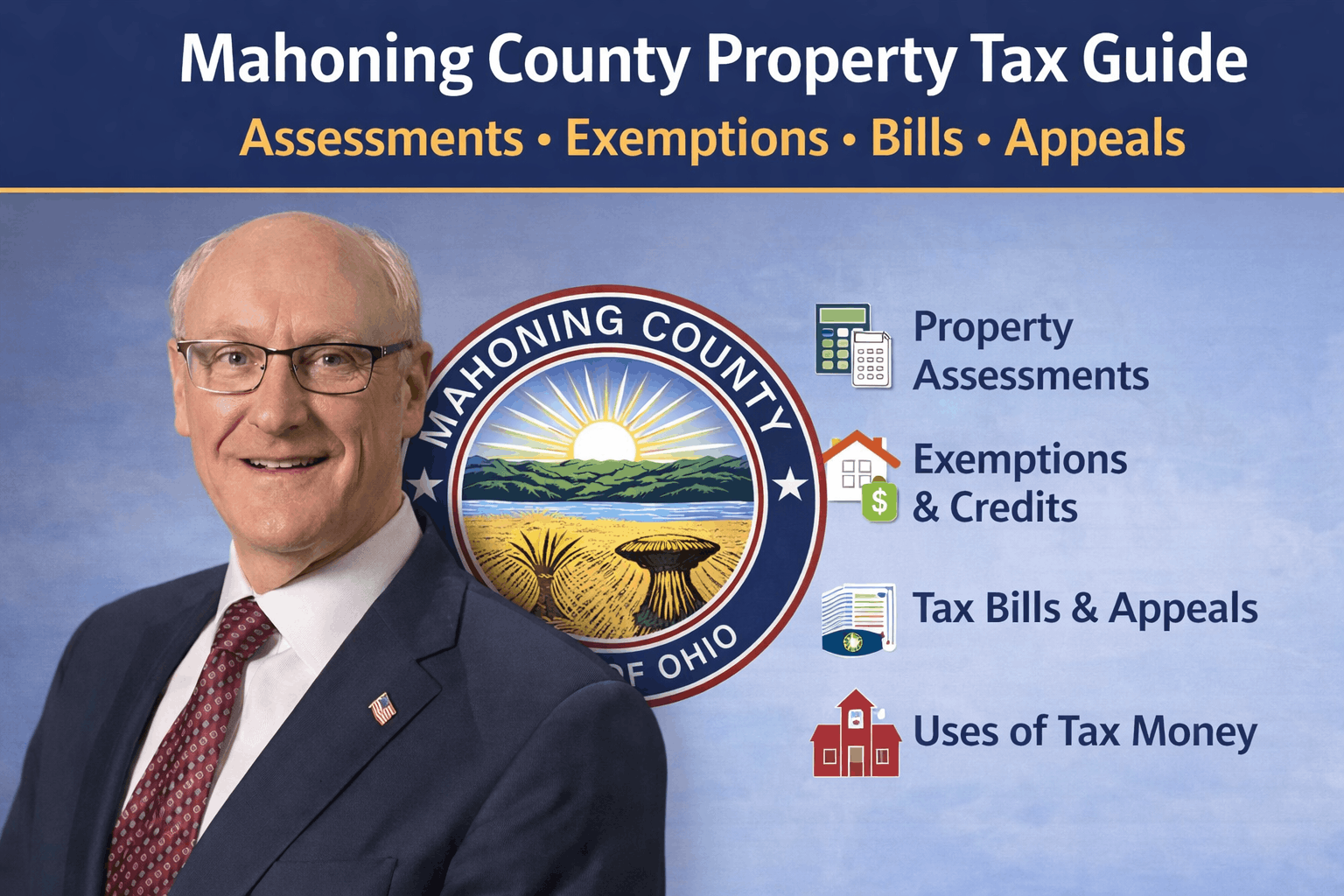
Property Tax Exemptions and Credits
Mahoning County offers several property tax exemptions and credits to reduce the tax burden for eligible residents:
1. Homestead Exemption
- Reduces taxes for senior citizens, disabled residents, and certain veterans on their primary home.
2. Owner-Occupied Exemption
- Lowers property taxes for owners living in their property as their primary residence.
3. Rollback Credits
- State-mandated reductions for residential and agricultural properties.
4. Additional Local Credits
- Some townships or school districts offer extra credits for low-income or special-needs property owners.
Tip: Eligibility varies by age, income, disability status, or property type. Apply through the Mahoning County Auditor’s Office to claim exemptions or credits.
How to Appeal Your Property Valuation
If you believe your Mahoning County property valuation is too high, you can file an appeal to potentially lower your property taxes.
Steps to Appeal:
- Review Your Property Record
- Check your assessed value, property description, and comparable properties on the Mahoning County Auditor’s website.
- Contact the Auditor’s Office
- Discuss discrepancies or errors before filing a formal appeal.
- File a Formal Complaint
- Submit a Board of Revision (BOR) complaint within the state’s deadline (usually by March 31).
- Provide Evidence
- Include recent appraisals, photos, or comparable sales to support your claim.
- Attend a Hearing
- Present your case to the BOR; the board may adjust your assessed value based on evidence.
Tip: Keep copies of all documents and meet deadlines to ensure your appeal is valid.
Understanding Your Property Tax Bill
Your Mahoning County property tax bill shows how much you owe and why. Key elements include:
1. Assessed Value
- Based on 35% of your property’s market value.
2. Millage Rate
- The combined rate from your school district, township, city/village, and county.
3. Exemptions and Credits
- Reductions like homestead, rollback, or owner-occupied credits are applied here.
4. Payment Details
- Shows due dates, installment options, and total amount owed.
5. Levy Information
- Lists voter-approved levies funding schools, safety, and local services.
Tip: Always check your tax bill carefully to ensure accuracy and avoid penalties. Contact the Mahoning County Auditor or Treasurer if you see errors.
Where Property Tax Money Goes
Property taxes in Mahoning County fund a variety of local services and programs:
1. School Districts
- The largest portion supports public schools, teacher salaries, and educational programs.
2. Townships, Cities, and Villages
- Pay for roads, police, fire, and local services.
3. County Government
- Funds courts, public health, and administrative services.
4. Voter-Approved Levies
- Additional funding for schools, safety, infrastructure, and special projects.
Important Offices and Resources
| Office / Resource | Role / Purpose |
|---|---|
| Mahoning County Auditor’s Office | Handles property assessments, exemptions, and valuations |
| Mahoning County Treasurer’s Office | Accepts property tax payments, provides payment history and due dates |
| Board of Revision (BOR) | Handles property valuation appeals |
| Local Townships, Cities, and Villages | Provide info on municipal levies, local services, and special credits |
| Ohio Department of Taxation | Provides state-level guidance on property taxes, exemptions, and rules |
Conclusion
Understanding Mahoning County property taxes is essential for homeowners, investors, and business owners. Knowing how taxes are calculated, where your money goes, available exemptions, and how to pay or appeal ensures you can plan finances confidently and avoid penalties. Use local resources such as the Auditor, Treasurer, and Board of Revision to stay informed, verify assessments, and take full advantage of credits or exemptions.
1. How are property taxes calculated in Mahoning County?
Property taxes are based on 35% of your property’s market value, multiplied by the combined millage rate from your school district, township, city/village, and county.
2. When are property taxes due?
Taxes are typically due in two installments, with exact dates listed on your tax bill from the Mahoning County Treasurer.
3. Can I appeal my property valuation?
Yes, you can file an appeal with the Board of Revision (BOR) if you believe your property’s assessed value is too high.
4. What exemptions or credits are available?
Residents may qualify for homestead, owner-occupied, rollback, or local voter-approved credits, depending on eligibility.
5. How can I pay my property taxes?
Payments can be made online, by mail, in person at the Treasurer’s office, or through participating banks.
6. Where does my property tax money go?
Taxes fund school districts, local townships/cities, county operations, and voter-approved projects such as safety or infrastructure improvements.
7. How do I find my property’s school district or tax district?
Check your property record on the Mahoning County Auditor’s website to see the linked school district and applicable millage rates.