
In Mahoning County, your property tax burden is directly tied to the “Appraised Value” set by the County Auditor. If you believe the official valuation of your home or business is higher than its actual market value, you have the legal right to challenge it. This process is handled through the Board of Revision (BOR).
This guide provides a comprehensive look at how to navigate the 2026 appeal process, gather the right evidence, and potentially save hundreds of dollars on your annual tax bill.
What is the Mahoning County Board of Revision?
The Board of Revision is a quasi-judicial body created to ensure that property valuations are fair and accurate. It acts as an intermediary between the taxpayer and the Auditor’s office. The board consists of three specific county officials:
- The County Auditor
- The County Treasurer
- The President of the Board of County Commissioners
The board’s primary role is to hear complaints regarding the valuation of real property not to change tax rates, which are set by voters and local levies.
Why You Should File a Valuation Appeal
Filing an appeal is a strategic move for any property owner who can prove their assessment is inaccurate. Common reasons for a successful appeal include:
- Recent Purchase Price: If you bought your property recently for a lower price than the Auditor’s current valuation.
- Significant Property Damage: Structural issues, fire damage, or foundation problems that have not been accounted for in the latest assessment.
- Neighborhood Market Trends: If similar homes (comparables) in your immediate area have sold for significantly less than your appraised value.
- Errors in Data: Incorrect square footage, room counts, or land acreage listed in the Auditor’s database.
The 2026 Step-by-Step Appeal Process
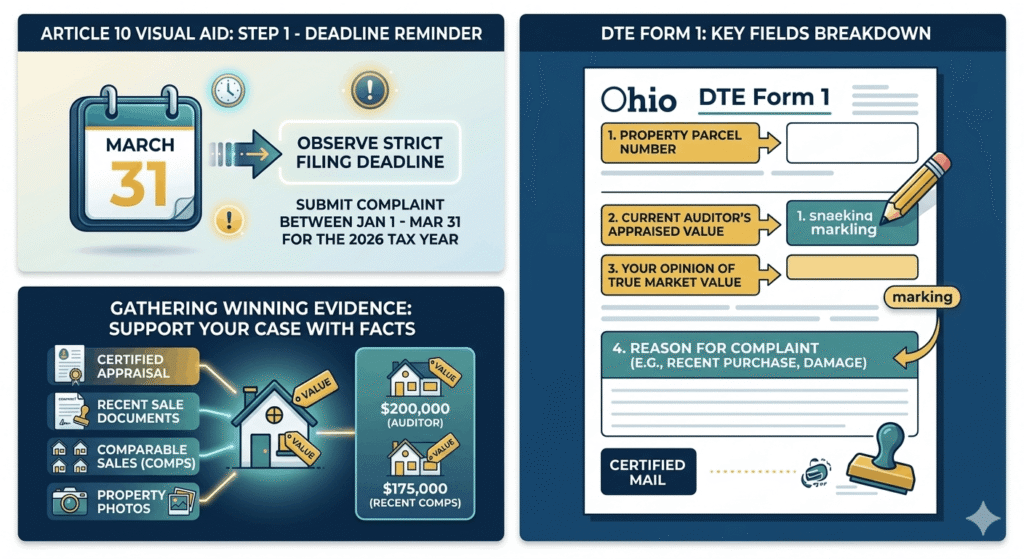
1. Observe the Strict Filing Deadline
In Ohio, the window to file a valuation complaint is very specific. You must submit your application between January 1st and March 31st. If you miss the March 31st deadline, you will lose your right to appeal for that tax year.
2. Complete Form DTE 1
To initiate the process, you must file DTE Form 1: Complaint Against the Valuation of Real Property. This form requires:
- Your specific Parcel Number (found on your tax bill).
- The Auditor’s current market value.
- Your opinion of the true market value as of January 1st of the tax year.
3. Gather “Winning” Evidence
The Board of Revision relies on facts, not opinions. To win your case, you should provide:
- Professional Appraisal: A recent report from a certified independent appraiser is the strongest evidence.
- Certified Closing Statements: If the property was purchased within the last year in an arm’s-length transaction.
- Comparable Sales (Comps): A list of at least three similar properties nearby that sold recently for less than your value.
- Contractor Estimates: If you are claiming damage, provide written quotes for the necessary repairs.
What Happens During the BOR Hearing?
Once your complaint is processed, you will receive a notice for a formal hearing, usually held at the Auditor’s office in Youngstown.
- Presentation: You (or your attorney) will have roughly 10-15 minutes to present your evidence to the board members.
- Cross-Examination: Representatives from the Auditor’s office or the local school board may ask questions about your evidence.
- The Decision: The board rarely makes a decision on the spot. You will typically receive a written decision via certified mail within 30 to 90 days.
Quick Reference: Appeal Facts
| Feature | Details |
| Filing Window | January 1 – March 31, 2026 |
| Cost | No filing fee ($0) |
| Key Document | DTE Form 1 |
| Location | 120 Market St, Youngstown, OH |
| Legal Representation | Optional (but recommended for commercial properties) |
Conclusion: Take Control of Your Property Taxes
The Mahoning County Board of Revision is your best defense against over-taxation caused by inflated property values. By understanding the timeline and preparing a fact-based case, you can ensure that your tax bill reflects the true market reality of your property. Don’t leave your financial health entirely in the hands of automated assessment algorithms exercise your right to a fair review in 2026.