Transferring property ownership in Mahoning County involves more than just a handshake and a set of keys. It is a formal legal and administrative journey that must navigate the offices of the Mahoning County Auditor and the Mahoning County Recorder. Whether you are selling a home, gifting property to a family member, or managing an inheritance, understanding the rules of deed transfers can save you significant time, money, and legal headaches.
1. Understanding the Role of the Auditor and Recorder
In Mahoning County, the deed transfer process is a two-step verification system.
The Mahoning County Auditor
The Auditor’s primary role is to maintain the county’s real estate tax list and ensure that the property’s valuation is accurate. Before a deed can be officially recorded, the Auditor must review it to:
- Verify the legal description and Parcel Number.
- Ensure all property taxes are current or accounted for.
- Collect the mandatory Conveyance Fee.
The Mahoning County Recorder
Once the Auditor has “transferred” the property in their system and stamped the deed, it moves to the Recorder’s office. The Recorder makes the document part of the public record. Until a deed is recorded here, the transfer is not considered legally complete in the eyes of the public or future creditors.
2. Common Types of Deeds Used in Ohio
Selecting the right deed is critical for your legal protection. Ohio recognizes several specific types of deeds:
General Warranty Deed
This is the gold standard for property sales. It provides a guarantee from the seller (grantor) that the title is clear of any liens or defects and that they have the full legal right to sell the property.
Quitclaim Deed
Commonly used for family transfers, divorces, or moving property into a business entity. A Quitclaim deed transfers whatever “interest” the person has in the property without making any guarantees about the title’s history.
Survivorship Deed
This is essential for married couples or co-owners. If one owner passes away, the property automatically transfers to the surviving owner without the need for a lengthy and expensive stay in Probate Court.
3. The Step-by-Step Deed Transfer Process
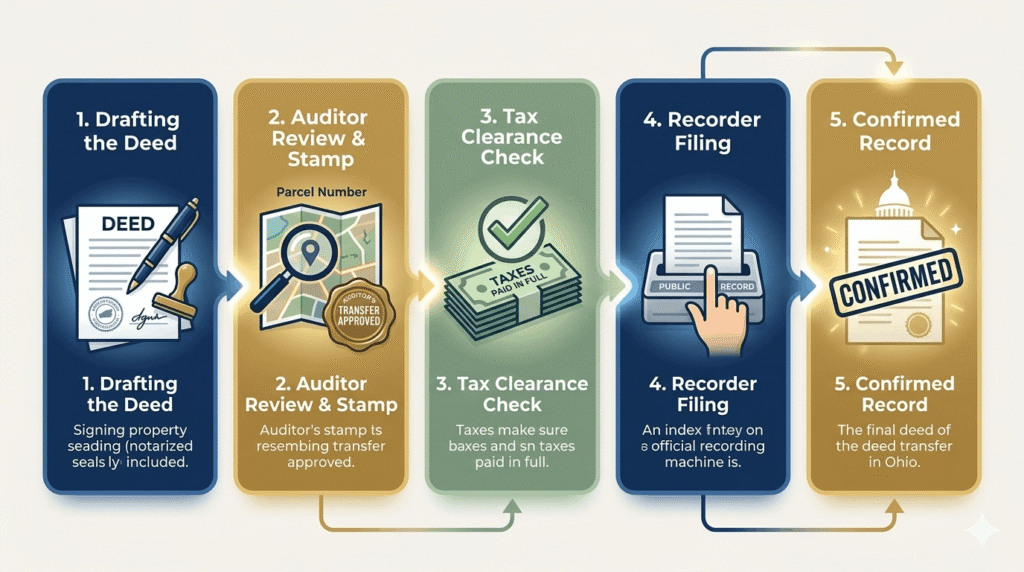
Step 1: Drafting the Deed
A deed must contain the names of the Grantor (seller) and Grantee (buyer), the full legal description of the property, and the specific Permanent Parcel Number (PPN).
- Pro Tip: In Ohio, all deeds must be signed in the presence of a Notary Public to be valid for recording.
Step 2: The Auditor’s “Transfer” Stamp
Take the notarized deed to the Mahoning County Auditor’s office. They will check if the property has any “Special Assessments” or delinquent taxes. If everything is clear, they will apply a transfer stamp.
Step 3: Paying Conveyance Fees
Mahoning County requires a conveyance fee (transfer tax) on most property sales.
- The Calculation: The fee is typically $4.00 per every $1,000 of the sale price.
- Exemptions: If the transfer is a gift or part of a trust, you may be exempt from this fee, but you must still file a “Statement of Reason for Exemption” (DTE 100EX).
Step 4: Final Recording
The final step is filing the stamped deed with the Mahoning County Recorder. This officially updates the “Chain of Title.”
4. The Importance of Dower Rights in Ohio
One of the most common reasons deed transfers fail in Mahoning County is the oversight of Dower Rights. Ohio is one of the few remaining states that recognizes dower.
- The Rule: If a married person owns property in their name only and decides to sell it, their spouse still has a legal interest in that property.
- The Requirement: The non-owning spouse must sign the deed to release their dower rights, even if they have never lived in the home.
5. Avoiding Common Pitfalls
- Unpaid Taxes: If the property has delinquent taxes, the Auditor may halt the transfer until they are paid. This is where Tax Foreclosure Guide becomes essential reading.
- Incorrect Legal Descriptions: Even a tiny typo in the parcel number can result in the deed being rejected by the county offices.
- Missing Signatures: Ensure all parties, including spouses for dower release, have signed and been notarized.
Frequently Asked Questions (FAQs)
Can I transfer property to my children for $1.00?
Yes, this is common in family planning. While the sale price is low, the Auditor will still require an exemption form to verify it is a bona fide gift and not a market sale
Do I need a lawyer for a deed transfer?
While you can technically draft your own deed, any error can cloud the title for decades. It is highly recommended to use an attorney or a title company to ensure the legal description is perfect.
What is a Transfer on Death (TOD) Affidavit?
This is a popular alternative to a deed transfer. It allows you to name a beneficiary who will receive the property upon your death, avoiding probate entirely while allowing you to retain full ownership during your lifetime.
Conclusion
Mastering the Mahoning County deed transfer process is essential for securing your property’s legal future. While the path from the Auditor’s tax verification to the Recorder’s final filing may seem technical, following the correct legal steps ensures a seamless transition of ownership. By addressing key requirements like dower rights and conveyance fees early, you protect your investment from future title disputes. Remember, a correctly recorded deed is more than just paperwork it is the ultimate legal shield for your property rights in Mahoning County.