
Navigating a Mahoning County Tax Foreclosure can be a daunting experience for any property owner, but understanding your legal options is the first step toward saving your home. In Ohio, the legal process for tax delinquency is highly structured, providing homeowners with multiple ‘exit ramps’ and opportunities to prevent a total loss if they act quickly. This comprehensive guide covers everything from the initial delinquency notice to the final Sheriff’s Sale, offering actionable steps to protect your equity and your property.
1. Understanding Tax Delinquency: When Does the Clock Start?
In Mahoning County, property taxes are billed in arrears and paid in two installments (typically February and July). If a payment is missed, the property is officially classified as delinquent.
The Penalty Phase
The moment a deadline passes, the Auditor’s office applies a 10% penalty to the unpaid amount. If you fail to pay within the first ten days of the grace period, this penalty sticks. Furthermore, interest begins to accrue on the unpaid balance twice a year (in December and August).
- Pro Tip: If you missed the deadline by just a day or two due to an emergency, you can file a “Remission of Penalty” form with the Board of Revision to request a one-time waiver of the 10% fee.
2. The Delinquent Tax List & Public Notice
If taxes remain unpaid for a full year, the Mahoning County Treasurer is required by law to publish a Delinquent Tax List in local newspapers.
- The Impact: Having your name and address published is a formal step toward foreclosure. It also alerts “predatory” investors who may try to buy your debt or pressure you into a quick, low-ball sale.
- The Solution: Contact the Treasurer’s office immediately to enter into a Delinquent Tax Payment Plan.
3. The Delinquent Tax Payment Plan (Your First Lifeline)
Ohio law (ORC 323.31) allows the County Treasurer to enter into a written agreement with a delinquent owner. This is often called a “Stay of Foreclosure”.
How it Works:
- Down Payment: You typically pay a percentage of the back taxes upfront.
- Installments: The remaining debt is spread over several months (up to 60 months in some cases).
- Current Taxes: You must continue to pay all new tax bills on time while paying off the old debt.
- Warning: If you miss a single payment on your plan, the agreement is breached, and the Treasurer can immediately initiate the foreclosure lawsuit.
4. The Judicial Foreclosure Process
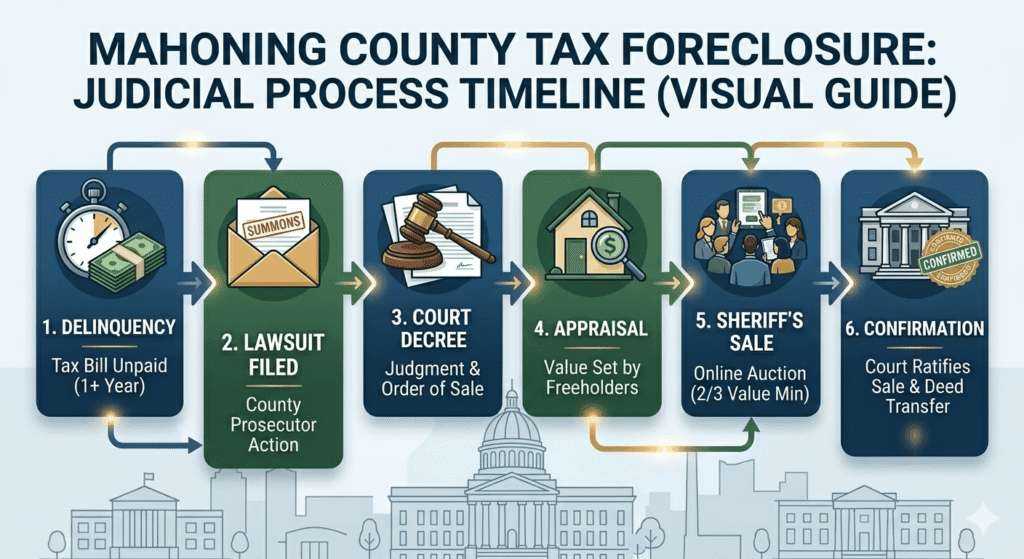
If no payment plan is made, the County Prosecutor will file a civil lawsuit on behalf of the Treasurer. This is a Judicial Foreclosure.
The Legal Steps:
- The Complaint: You will receive a “Summons and Complaint” via certified mail. You have 28 days to file an answer.
- The Judgment: If you don’t answer or pay, the court grants a “Finding and Decree of Sale”.
- The Appraisal: Three disinterested freeholders (local residents) will estimate the value of your home to set the minimum bid for the auction.
5. The Sheriff’s Sale: What Happens at Auction?
Once the court orders the sale, the property is advertised for three consecutive weeks. The auction usually takes place online via the Official Ohio Public Real Estate Auction website. Check our full guide on how Mahoning County Sheriff Sales work.
- Minimum Bid: Generally, the property must sell for at least two-thirds (2/3) of its appraised value.
- No-Sale: If the property doesn’t sell at the first auction, a second auction is held, often with no minimum bid requirement (just costs and taxes).
6. The Right of Redemption: The “Last Minute” Save
Most homeowners don’t realize they can save their home even after the auction has ended. This is called the Right of Redemption.
- The Window: You can redeem the property anytime BEFORE the court confirms the sale. This confirmation usually happens 30 to 60 days after the auction.
- The Cost: To redeem, you must pay the full amount of delinquent taxes, all penalties, interest, and the court costs associated with the foreclosure.
7. Strategies to Avoid Foreclosure in Mahoning County
A. Challenge the Valuation
If your taxes are high because the Auditor thinks your house is worth $200k but it’s actually worth $100k, you must file a Board of Revision (BOR) appeal. Lowering the value lowers the tax debt.
B. Apply for Retroactive Credits
Check if you were eligible for the Homestead Exemption or Owner-Occupancy Credit in previous years but forgot to apply. The Auditor can sometimes apply these credits retroactively for up to three years, reducing your total debt.
Conclusion: Action is Your Best Defense
A tax foreclosure in Mahoning County is a slow-moving process, but it is relentless. Whether it is through a payment plan, a valuation appeal, or a private sale to preserve your equity, you have options. Do not wait for the Sheriff to knock on your door. Contact the Mahoning County Treasurer’s Office today to discuss a payment plan.
Frequently Asked Questions (FAQs)
Can the county take my home for just $1,000 in back taxes?
Technically, yes. Ohio law does not set a minimum dollar amount for tax foreclosure. However, the county usually prioritizes properties that are several years behind
What happens to the “extra” money if my house sells for more than the taxes owed?
If your home sells at a Sheriff’s Sale for $100,000 but you only owed $10,000 in taxes, the remaining $90,000 belongs to you. You must file a motion with the court to claim these “Surplus Funds”.
Does bankruptcy stop a tax foreclosure?
Yes, filing for bankruptcy triggers an “Automatic Stay,” which halts the foreclosure process. However, the tax debt is generally not discharged.
How long do I have to move out after the Sheriff’s Sale?
Once the sale is confirmed and the deed is recorded, the new owner receives a “Writ of Possession.” At that point, the Sheriff will give you a formal notice to vacate, usually within 10 to 14 days.