
For many homeowners in Mahoning County, the arrival of the property tax bill in the mail is met with confusion. Filled with technical jargon, complex mathematical formulas, and various “millage” rates, it can be difficult to understand exactly what you are paying for. However, understanding your tax bill is the first step toward ensuring you aren’t overpaying and identifying opportunities for significant tax relief.
This guide provides a detailed breakdown of the Mahoning County property tax bill, explaining how taxes are calculated, where the money goes, and how you can legally reduce your tax burden.
1. Anatomy of the Mahoning County Tax Bill
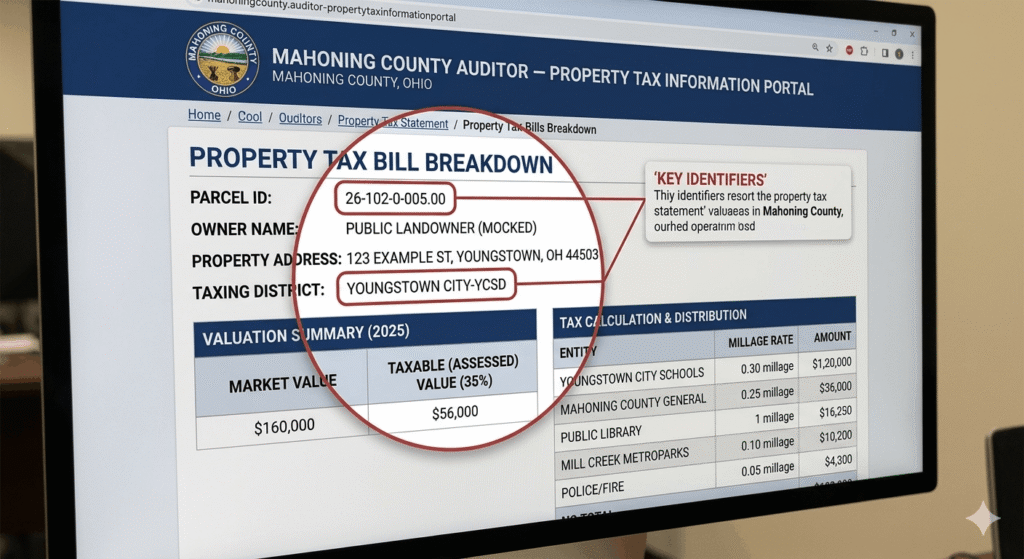
When you open your bill, several key identification markers and financial figures stand out. Understanding these is essential for any homeowner.
The Permanent Parcel Number (PPN)
Your Parcel Number is the most important identifier on the bill. Unlike your street address, which can sometimes be duplicated or changed, the PPN is a unique numerical code assigned to your specific piece of land. Always reference this number when contacting the Auditor’s or Treasurer’s office.
Market Value vs. Assessed Value
One of the most common points of confusion is the difference between what your house is worth and what you are taxed on.
- Total Market Value: This is the Auditor’s estimate of what your property would sell for on the open market.
- Assessed Value (Taxable Value): In Ohio, property taxes are not calculated on 100% of the market value. Instead, they are calculated on 35% of the appraised market value. For example, if your home is valued at $200,000, your taxes are calculated based on an assessed value of $70,000.
Taxing District
Your bill will list a specific taxing district. This determines which local levies apply to you. Even if two houses are on the same street, if they fall into different school districts or municipal boundaries, their tax rates will differ.
2. How Your Property Tax is Calculated
The math behind your tax bill relies on a unit of measurement called a “mill.”
Understanding “Mills”
A “mill” represents $1 of tax for every $1,000 of assessed property value. To calculate your gross tax, the county multiplies your assessed value by the total millage rate approved for your district.
Voted Levies vs. Effective Rates
Ohio has a unique “tax reduction factor” (H.B. 920). This law prevents inflation from increasing the amount of money a specific levy collects. As property values rise, the “effective” tax rate of a levy actually decreases so that the taxing authority (like a school or library) only collects the specific dollar amount originally voted for by the public.
Property Tax Calculation Table
| Item Description | Calculation Method | Example Value |
| Market Value | Total Appraised Value | $200,000 |
| Assessed Value | 35% of Market Value | $70,000 |
| Millage Rate | Voted Local Rate (e.g., 80 mills) | 0.080 |
| Gross Annual Tax | Assessed Value x Millage | $5,600 |
| Reduction Factor | H.B. 920 Credits | -$1,200 (est.) |
| Net Annual Tax | Total Amount Owed | $4,400 |
3. Where Does Your Tax Money Go?
Your property tax is not a single fee; it is a collection of funds distributed to various local services. In Mahoning County, the distribution typically follows this pattern:
- Public Schools (50% – 65%): The largest portion of your bill goes toward funding local K-12 education, vocational schools, and special education programs.
- County Government (15% – 20%): This supports the court system, the Sheriff’s Department, and general administrative services.
- Municipal/Township Services: This covers local police, fire protection, street lighting, and road maintenance.
- Voted County Levies: These are smaller portions that fund specific community assets, such as the Public Library of Youngstown and Mahoning County, Mill Creek MetroParks, and Mental Health services.
4. Key Deadlines and Payment Options
In Mahoning County, property taxes are paid “in arrears,” meaning you pay for the previous year’s taxes in the current year.
- First Half Due Date: Typically falls in February.
- Second Half Due Date: Typically falls in July.
Failure to pay by these deadlines results in a mandatory 10% penalty on the unpaid balance. If you find yourself struggling to pay, the Mahoning County Treasurer often offers “Delinquent Tax Payment Plans” to help homeowners avoid foreclosure.
5. How to Lower Your Mahoning County Tax Bill
Many residents pay more than they need to because they aren’t aware of available exemptions.
The Homestead Exemption
This is the most significant tax break for senior citizens (65+) and permanently disabled individuals. It allows qualifying homeowners to shield $26,200 of their home’s market value from taxation.
Owner-Occupancy Credit (2.5% Reduction)
If you live in the home you own, you are entitled to a 2.5% reduction on the taxes related to voted levies. Ensure your bill shows this credit; if it doesn’t, you may need to file an application with the Auditor.
CAUV (Current Agricultural Use Value)
For owners of large plots of land (usually 10+ acres) used for commercial agriculture, the CAUV program allows the land to be taxed based on its agricultural value rather than its potential development value, often resulting in massive savings.
The Board of Revision (BOR)
If you believe the Auditor has overvalued your property, you have the right to file a complaint with the Board of Revision between January 1st and March 31st. You must provide evidence, such as a recent appraisal or sales of comparable homes in your neighborhood, to justify a value reduction.
6. Common Errors to Look For
Review your bill carefully for these frequent mistakes:
- Missing Exemptions: Check if your Homestead or Owner-Occupancy credits are missing.If you are a new owner, check our Deed Transfer Guide to ensure your bill is updated.
- Incorrect Property Classification: Ensure your property is listed as “Residential” and not “Commercial” if it is your home.
- Special Assessments: Check for charges like “Weed Cutting” or “Demolition” fees that might have been applied to the wrong parcel.
Conclusion
Your Mahoning County property tax bill is a vital document that reflects your contribution to the community’s infrastructure and safety. By understanding the breakdown of assessed values, millage rates, and available exemptions, you can take control of your finances and ensure you are only paying your fair share. Staying informed about local levies and deadlines is the best way to be a responsible and savvy property owner in Mahoning County.
FAQs
How is the tax bill calculated in Mahoning County?
Taxes are based on 35% of your property’s market value (Assessed Value). This figure is multiplied by your local district’s millage rate, and then state credits like H.B. 920 are applied to find the final amount.
What are the property tax due dates?
Mahoning County taxes are paid in two halves: the First Half is usually due in February, and the Second Half in July. Missing these deadlines triggers a mandatory 10% penalty.
How can I lower my property tax bill?
You can reduce your bill through the Homestead Exemption (for seniors/disabled), the 2.5% Owner-Occupancy Credit, or the CAUV program for agricultural land.
Can I challenge my home’s valuation?
Yes, you can file a valuation complaint with the Board of Revision (BOR) between January 1st and March 31st if you believe the Auditor’s market value estimate is too high.
Where does my tax money go?
The majority of your tax dollars (over 50%) fund local school districts, while the rest supports police, fire services, libraries, and county infrastructure.