Property taxes are a significant expense for homeowners in Youngstown and throughout Mahoning County. However, many residents don’t realize that the tax bill they receive is based on an assessed value that may not reflect the actual market reality. If you believe your property is overvalued, you have the legal right to challenge it. If you want to appeal Mahoning County property tax in 2026, this guide will show you the exact steps
In this comprehensive guide, we will walk you through the process of filing an appeal with the Mahoning County Board of Revision (BOR), gathering evidence, and maximizing your chances of a successful tax reduction in 2026.
Why You Should Consider Appealing Your Assessment
The Mahoning County Auditor’s office performs property valuations to determine the amount of tax owed. However, these mass appraisals often miss specific details about your home. You should consider an appeal if:
- Market Discrepancy: Your home’s assessed value is significantly higher than recent sales of similar homes in your neighborhood.
- Property Damage: Your property has structural issues, basement flooding, or other damage that reduces its market value.
- Incorrect Data: The Auditor’s records show more square footage, bedrooms, or bathrooms than your home actually has.
Key Deadlines for the 2026 Tax Year
Timing is everything when it comes to tax appeals. In Ohio, the window to file a complaint against the valuation of real property is very specific.
- Filing Period: Complaints can usually be filed between January 1st and March 31st.
- Current Year: For the 2026 tax cycle, your application must be postmarked or hand-delivered by the end of March to be considered for the current year’s billing.
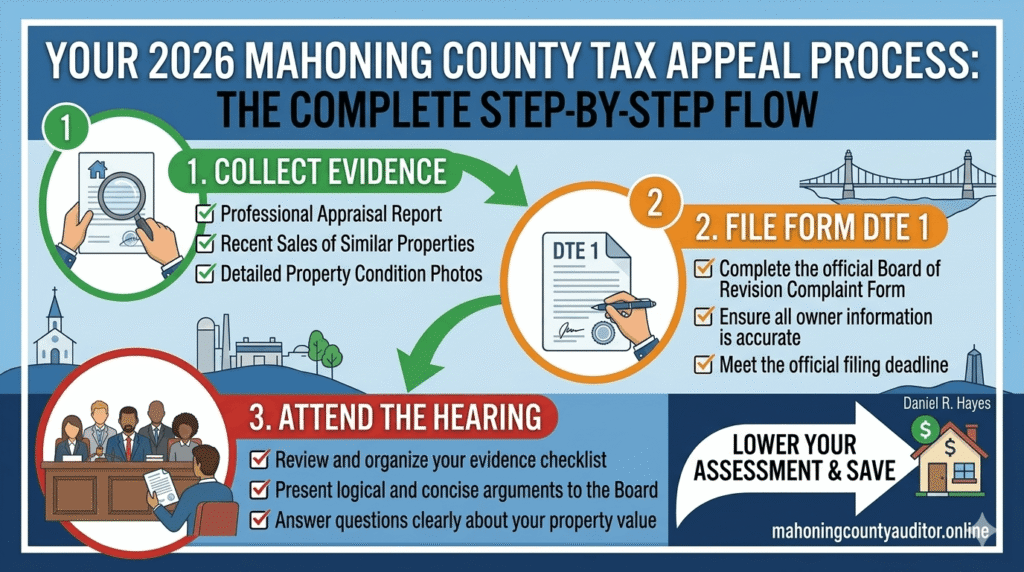
Step 1: Gathering Evidence for Your Appeal
The Board of Revision will not lower your taxes just because you feel they are “too high.” You must prove that the Market Value is incorrect.
A. Recent Sales Comparison (Comps)
Look for at least 3 to 5 properties in your immediate area that have sold in the last 12-24 months. These “comps” should be similar in size, age, and condition to your home. You can find these using the Mahoning County Property Search tool we discussed in our previous guide.
B. Independent Appraisal Reports
A professional appraisal is the strongest evidence you can present. While it costs money upfront (usually $400-$600), a certified appraisal specifically for a tax appeal often pays for itself in tax savings.
C. Photos of Property Damage or Issues
If your home requires major repairs (e.g., a failing roof or cracked foundation), take clear photos. Get written estimates from local contractors showing the cost of these repairs. The Board may reduce your value based on these “cost-to-cure” estimates.
Step 2: Filling Out Form DTE 1
To start the process, you must fill out Form DTE 1 (Complaint Against the Valuation of Real Property). This form is available on the Mahoning County Auditor’s website.
Crucial Tips for Filling the Form:
- Parcel Number: Ensure your 10-digit parcel ID is 100% correct.
- Owner’s Opinion of Value: This is the most important box. Don’t just guess; use the value supported by your comps or appraisal.
- Notarization: Form DTE 1 must be signed in the presence of a Notary Public.
Step 3: What Happens During the Board of Revision Hearing?
Once you file, you will receive a notice for a hearing. The board usually consists of the County Auditor, a member of the Board of County Commissioners, and the County Treasurer (or their representatives).
What to Expect:
- Presentation: You will have 10-15 minutes to present your evidence.
- Questions: The board may ask you about your purchase price or specific conditions of the home.
- The School Board: Be aware that local school districts can also attend and argue against your reduction if the requested amount is large.
Daniel’s Pro-Tip: “Always be respectful but firm. Stick to the data. Don’t talk about how hard it is to pay the taxes focus entirely on why the home wouldn’t sell for the Auditor’s price on the open market.”
Common Mistakes to Avoid
- Comparing Taxes, Not Values: Don’t argue that your neighbor pays less tax. Argue that your neighbor’s house is worth more but valued less.
- Missing the Deadline: Even one day late will result in an automatic dismissal.
- Lack of Evidence: Oral testimony without documents (photos, sales data, appraisals) rarely succeeds.
Conclusion: Taking Control of Your Property Taxes
Appealing your Mahoning County property taxes is a powerful way to ensure you are only paying your fair share. By following this step-by-step guide and preparing your evidence diligently, you can navigate the Board of Revision process with confidence.
FAQs
Does an appeal always lower my taxes?
Not necessarily. The Board can choose to keep the value the same, decrease it, or in rare cases (if evidence suggests), even increase it.
How long does the process take?
After filing by March, hearings usually take place in the summer or fall. You will receive a written decision a few weeks after your hearing.
Can I appeal every year?
In Ohio, you can generally only file one appeal in a three-year “interim” period unless there has been a significant change in the property (like a fire or a new addition).