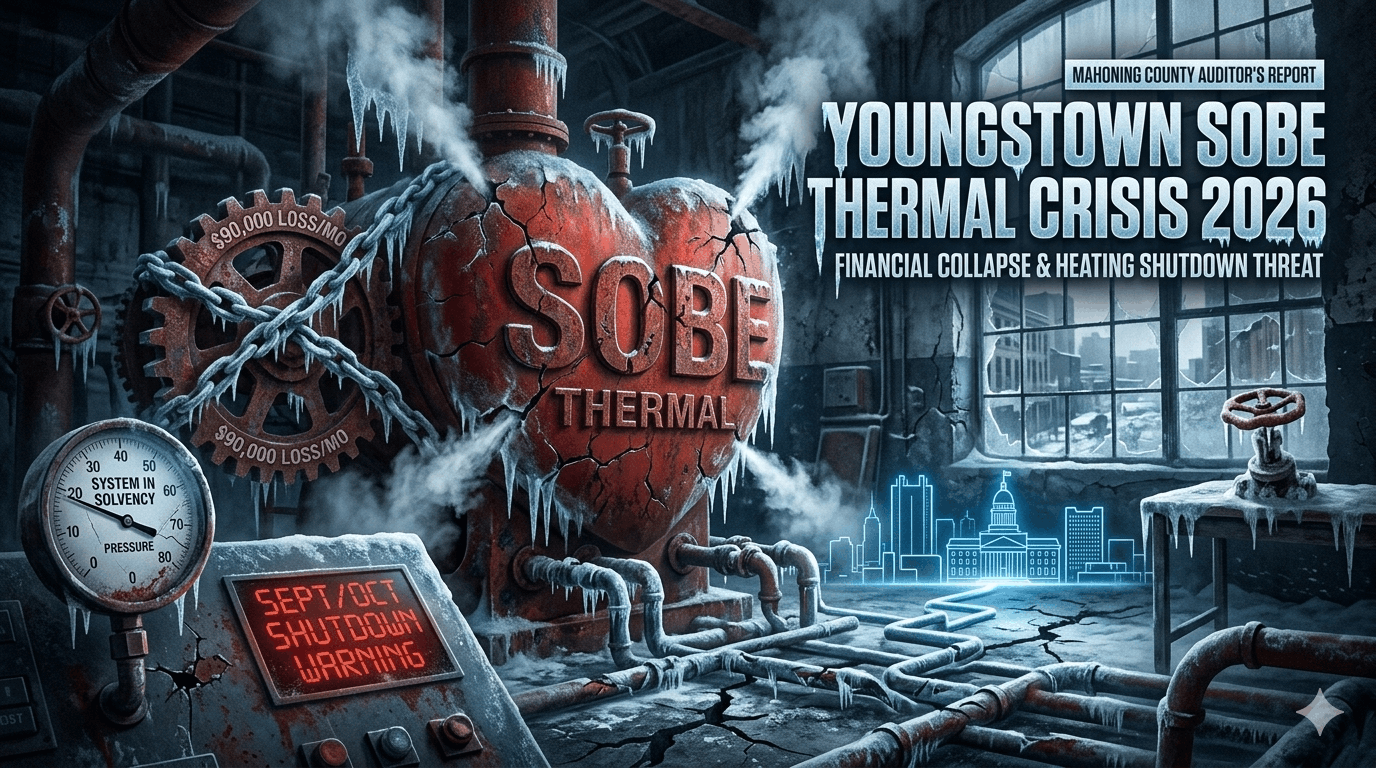
Downtown Youngstown, Ohio is currently facing an unprecedented energy and infrastructural emergency. SOBE Thermal Energy Systems LLC, the district utility responsible for providing essential steam heat and hot water to over two dozen major downtown buildings, is on the brink of total financial collapse. With a court-appointed receiver painting a bleak picture, a multi-million dollar debt mountain, and explicit warnings of a complete service shutdown by October 2026, property owners, local businesses, and city officials are bracing for a worst-case scenario.
This comprehensive breakdown covers the complete timeline of the SOBE crisis, the staggering financial numbers, the infrastructure failures, and the potential long-term solutions being evaluated by Youngstown City Council.
The Core Crisis: Income vs. Expenses & Impending October Shutdown
The crisis reached a tipping point when SOBE’s current court-appointed receiver, John C. Collins, submitted his first formal status report to Mahoning County Common Pleas Court Judge Anthony Donofrio. The financial assessment revealed that the utility company is operating under a highly unsustainable and fatal deficit.
Currently, SOBE’s monthly income stands at approximately $130,000, while its monthly operating expenses soar past $220,000. Operating at a staggering monthly loss of $90,000, the company is completely insolvent.
The receiver has explicitly warned the court that unless a major cash injection is provided or an emergency tariff increase is approved by the Public Utilities Commission of Ohio (PUCO), SOBE will be unable to pay for the three rented mobile boilers it relies on, forcing a complete operational shutdown by September or October 2026.
Complete Timeline of the SOBE Thermal Crisis
Wabash Repossession & Corporate Abandonment
September 30, 2025
SOBE’s CEO, David Ferro, defaulted on a lease agreement with Wabash Power Equipment Co., owing over $383,214 in back payments. Wabash repossessed the primary 800-horsepower mobile boiler, leaving downtown Youngstown completely without steam heat. Facing over $4 million in total debt to creditors, Ferro abandoned the Youngstown facility. The PUCO stepped in, declaring the utility insolvent, and the court placed SOBE into receivership, appointing Reg Martin as the first receiver.
The Historic Sub-Zero Heating Collapse
January – February 2026
During severe winter storms with temperatures plunging to 17 degrees below zero, the makeshift infrastructure managed by receiver Reg Martin completely failed. A ruptured water line shut down two mobile boilers. Later, an 800-horsepower replacement unit suffered system failure alongside a secondary 650-horsepower unit. A single, weak 200-horsepower boiler was left to heat the entire downtown. Multiple county buildings, businesses, and Youngstown City Hall were forced to shut down for days amid freezing indoor conditions.
Receiver Swap & Political Outrage
February 17, 2026
Following massive public outcry, business losses, and direct intervention from Ohio State Representative Lauren McNally, Judge Donofrio granted a PUCO motion to remove Reg Martin for mismanagement. Akron attorney John C. Collins was appointed as the new receiver at a rate of $300 per hour, tasked with auditing the entire company’s broken structure.
Youngstown Intervenes Legally
April 2026
The Mahoning County Common Pleas Court officially permitted the City of Youngstown to intervene as a legal party in the receivership case. The city filed a cross-claim against SOBE for $11,213.57 in unpaid municipal water bills and demanded legal protections to ensure local communication protocols during utility failures.
The Fatal Financial Report & Governor’s Refusal
June 2026
Receiver John C. Collins filed court papers warning of the October shutdown due to the monthly $90,000 deficit. Simultaneously, Ohio Governor Mike DeWine’s office officially confirmed that the state will not bail out the private utility using the state’s capital budget or rainy-day fund, citing legal restrictions on spending public bond dollars on private corporations.
Financial Breakdown: The Debt Mountain Facing SOBE
The financial problems plaguing SOBE Thermal go far beyond monthly rental fees. Years of structural neglect and unpaid utility bills have created a debt situation that makes private acquisition incredibly challenging.
The follow data outlines the verified liabilities and operational costs currently tied to the SOBE receivership case:
| Expense / Liability Type | Estimated Financial Amount | Status & Notes |
| Monthly Operating Income | $130,000 | Generated from its 28 remaining downtown customers. |
| Monthly Operating Expenses | $220,000 | Driven primarily by equipment rentals and fuel costs. |
| Monthly Net Operating Loss | $90,000 | The structural deficit pushing the company to collapse. |
| Enbridge Gas Ohio Arrearage | Up to $1,999,656.95 | Unpaid natural gas bills accumulating since before late 2025. |
| Power Mechanical Boiler Rental | $58,200 / month | Cost to rent the three active mobile steam boilers. |
| Total Debt Inherited from CEO | ~$4,000,000.00 | Total outstanding liabilities when David Ferro walked away. |
| Unpaid City Water Bill | $11,213.57 | Subject of the City of Youngstown’s active cross-claim. |
The Infrastructure Nightmare: Why the Plant is Dying
The root of SOBE’s operational failure lies in a completely obsolete infrastructure model. The original, historic steam plant boilers were demolished or decommissioned years ago. Instead of a permanent brick-and-mortar utility, the system is currently being kept alive by three rented mobile boilers parked on-site.
Furthermore, the system suffers from a critical lack of operational accountability:
- Missing and Inaccurate Meters: Receiver John C. Collins recently had to spend $39,364.60 just to install functional meters at four downtown businesses. Prior to this, several buildings had no meters at all, and many of the remaining buildings have old, heavily inaccurate meters that fail to read actual steam consumption correctly.
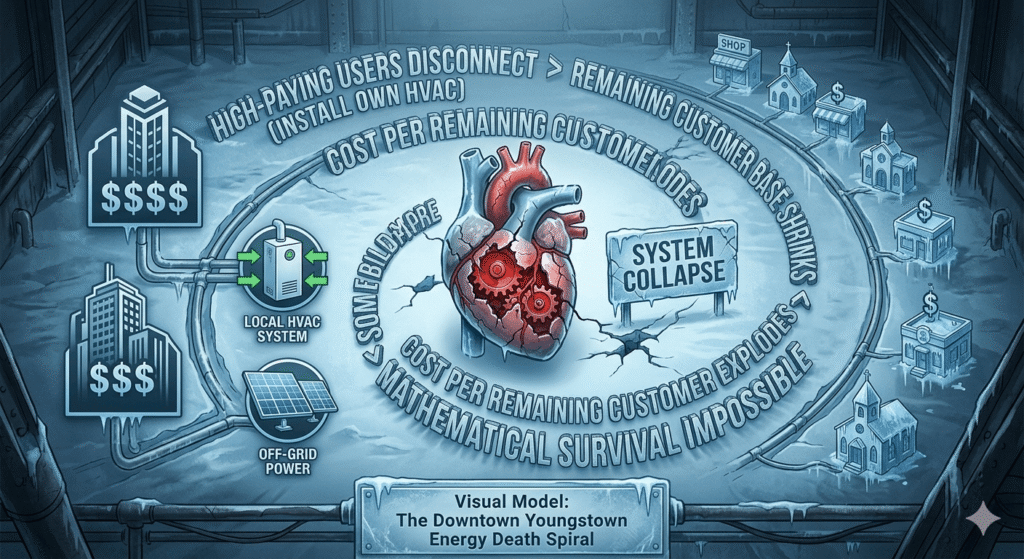
- The “Death Spiral” Risk: Because the infrastructure is highly unreliable, major downtown clients are actively looking for alternative heating systems. Mayor Derrick McDowell warned of a potential “death spiral”—if high-paying users completely disconnect from the system to install their own localized HVAC units, the remaining customer base will shrink, making it mathematically impossible for the utility to survive.
The $30 Million Reconstruction Plan: What Happens Next?
With the state of Ohio refusing a direct financial bailout, the City of Youngstown is left with very few viable choices. According to engineering data presented by Mayor Derrick McDowell to the City Council’s Utilities Committee, saving the district heating grid requires a complete, bottom-up rebuild.
The total cost to make the system fully self-sufficient stands at $30 million, broken down into two core phases:
- On-Site Steam Plant Reconstruction ($13 Million): Building a completely new, permanent, modern boiler facility on-site to replace the incredibly expensive $58,200/month mobile boiler rentals.
- Delivery Grid and Piping Upgrades ($17 Million): Excavating and replacing the aging, leaking distribution network of underground pipes that snake beneath downtown Youngstown’s streets.
City Council Explores Long-Term Options
In an effort to find a strategic way forward, Youngstown City Council introduced legislation to approve $130,000 to hire Roetzel & Andress Associates, an Akron-based law firm, to run a comprehensive operational audit and viability study. The firm will perform a deep dive into SOBE’s technical functionality and try to outline a financially sustainable blueprint.
Some local advocates suggest that the city should eventually acquire the entire grid through eminent domain or negotiated purchase and run it as a municipal “Enterprise Fund,” similar to public water and sewer departments. However, city leadership remains highly cautious about absorbing millions in private debt.
Summary for Downtown Property Owners and Stakeholders
The SOBE Thermal crisis is a slow-moving economic emergency for Youngstown. If the receiver cannot secure an emergency tariff increase from the PUCO to double customer rates, or if a private buyer with $30 million in capital does not step forward, downtown buildings face a catastrophic lack of heat before the winter of 2026 begins.
Property owners inside the district heating zone are strongly advised to keep a close eye on the upcoming June 17 City Council meeting, where local officials will vote on declaring a formal “local energy and public utility emergency” to force further state-level administrative intervention.
FAQs
What is the SOBE Thermal crisis?
The central district heating utility (SOBE) in downtown Youngstown is on the verge of financial collapse, operating at a $90,000 monthly deficit with over $4 million in outstanding liabilities.
Which buildings are affected by this?
Approximately 28 major downtown structures are impacted, including Youngstown City Hall, the Mahoning County Courthouse, county administrative offices, and numerous local businesses.
When could the heating system completely shut down?
The court-appointed receiver has explicitly warned that without emergency funding or an approved rate increase, the rented mobile boilers will be shut down by September or October 2026.
How much capital is required to permanently fix the infrastructure?
Engineering studies estimate that a complete modernization including building a new on-site steam plant and replacing leaking underground delivery pipes will cost $30 million.
What emergency action is the City Council taking right now?
Youngstown City Council has introduced legislation to spend $130,000 to hire an external law firm to conduct a comprehensive technical and operational audit before the winter of 2026 arrives.