Understanding Mahoning County Homestead Exemption Eligibility is the first step toward reducing your annual property tax bill in 2026.The Homestead Exemption is the most significant tax relief program available to Mahoning County residents, but qualifying for it in 2026 requires meeting specific age, disability, and income criteria. While many homeowners know the program exists, a large percentage fail to apply because they are unsure of the complex “Means-Testing” rules enforced by the Ohio Department of Taxation.
In this comprehensive guide, we will break down the exact eligibility requirements, the 2026 income brackets, and the specialized documentation needed to ensure your application is approved by the County Auditor without delays.
1. The Core Eligibility Pillars
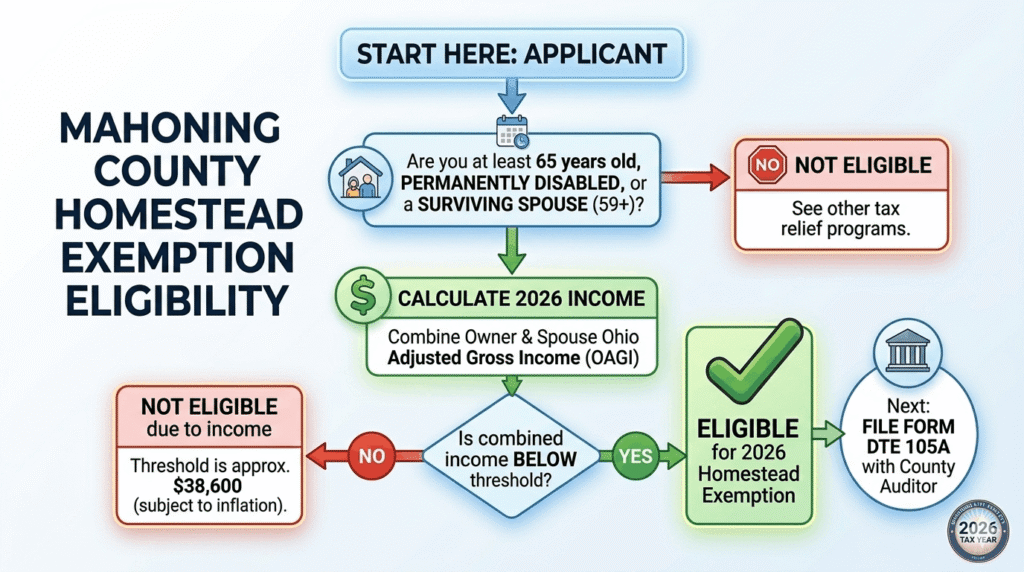
To qualify for the Homestead Exemption in Mahoning County, you must meet three fundamental requirements as of January 1st of the year you apply:
A. Home Ownership & Occupancy
You must be the owner of the property and it must be your primary residence (domicile). If you own multiple properties in Youngstown or Boardman, you can only claim the exemption on the one where you actually live.
B. Age or Disability Status
You must meet at least one of the following:
- Seniors: You must be at least 65 years old by December 31st of the year for which you are applying.
- Permanently Disabled: Individuals who are permanently and totally disabled (physically or mentally) can qualify regardless of age.
- Surviving Spouses: If your spouse was receiving the exemption at the time of their death and you were at least 59 years old, you may continue to receive the benefit.
2. The 2026 Income Limits (Means-Testing)
Since 2014, Ohio has implemented “Means-Testing” for new applicants. This means your Ohio Adjusted Gross Income (OAGI) must be below a certain threshold.
For the 2026 tax year, the income limit is approximately $38,600 (this is adjusted annually for inflation).
- Note: If you already had the Homestead Exemption before 2014, you are “grandfathered in” and do not have to meet this income requirement.
- What counts as income? Only the income of the owner and the owner’s spouse is considered. Social Security benefits are often excluded from the OAGI calculation, making it easier for retirees to qualify even if their total cash flow is higher than the limit.
| Category | Eligibility Criteria | Estimated Tax Benefit |
| Senior Citizens | Age 65+; Income under $38,600 | $26,200 reduction in market value |
| Disabled Persons | Permanently disabled; Income under $38,600 | $26,200 reduction in market value |
| Disabled Veterans | 100% service-connected (No income limit) | $52,300 reduction in market value |
| Surviving Spouses | Age 59+; Spouse was previously qualified | Varies based on previous status |
3. Specialized Categories: Disabled Veterans & First Responders
Mahoning County offers an Enhanced Homestead Exemption for those who have sacrificed in the line of duty. This is a “High-Value” section of your article because it targets a specific, loyal audience.
Disabled Veterans
Veterans who are 100% service-connected disabled are eligible for a much larger exemption. Instead of the standard $26,200 reduction in market value, veterans receive a $52,300 reduction. Most importantly, Veterans are NOT subject to the income means-test.
Surviving Spouses of First Responders
If a first responder was killed in the line of duty, their surviving spouse is eligible for the enhanced $52,300 exemption, regardless of income levels.
4. Documentation: Avoiding “Thin Content” Flags
To make this article “Unique” and “Helpful” for Google, you must list the exact documents required. This prevents the user from leaving your site to search elsewhere.
- For Seniors: A valid Ohio Driver’s License or State ID to prove age.
- For Disabled Individuals: A “Certificate of Disability” signed by a licensed physician or a social security award letter.
- For Veterans: A copy of the DD214 and the VA benefit letter confirming 100% disability.
- Income Proof: Your most recent Ohio State Income Tax Return.
5. Common Myths and Eligibility Pitfalls
Many Mahoning County residents miss out on savings because of these common misconceptions:
- Myth 1: “I have a Trust, so I don’t qualify.”
- Fact: If you have transferred your home into a revocable trust but still live there, you are still eligible for the exemption.
- Myth 2: “I need to re-apply every year.”
- Fact: Once approved, you do not need to re-apply unless you move to a new house or your income significantly changes.
- Myth 3: “It only applies to houses.”
- Fact: It applies to condos and even manufactured homes (mobile homes), provided you own the unit and pay property taxes on it.
Conclusion
Navigating the various rules for Mahoning County Homestead Exemption Eligibility is the most effective way for seniors, disabled individuals, and veterans to protect their financial well-being in 2026. While the application process may seem daunting, understanding whether you meet the age, disability, and income requirements is a one-time effort that results in years of significant property tax savings.
FAQs
What is the income limit for the Mahoning County Homestead Exemption in 2026?
The estimated income threshold for the 2026 tax year is approximately $38,600. This limit is based on your Ohio Adjusted Gross Income (OAGI) and is adjusted annually to account for inflation.
Do I need to re-apply for the exemption every year?
No, once your application is approved by the Mahoning County Auditor, you do not need to re-apply annually. You only need to file a new application if you move to a different primary residence or if there is a significant change in your eligibility status.
Can disabled veterans qualify if their income exceeds the limit?
Yes. Veterans who are 100% service-connected disabled are eligible for the Enhanced Homestead Exemption. One of the primary benefits of this status is that it is not subject to “means-testing,” meaning there is no income limit for qualified veterans.
Does the Homestead Exemption apply to mobile or manufactured homes?
Yes, the exemption applies to any property that serves as your primary residence, including manufactured or mobile homes, provided you own the unit and are responsible for the property taxes.