Managing property taxes is a fundamental responsibility for every homeowner in Ohio. The Mahoning County Property Tax system ensures that essential local services such as schools, police, fire protection, and public infrastructure are consistently and properly funded. In this 2026 updated guide, we will simplify the complexities of tax rates, explain how to interpret your official bill, and outline the various payment methods available through the County Treasurer’s office to help you avoid costly penalties.
How Your Mahoning County Property Tax is Calculated
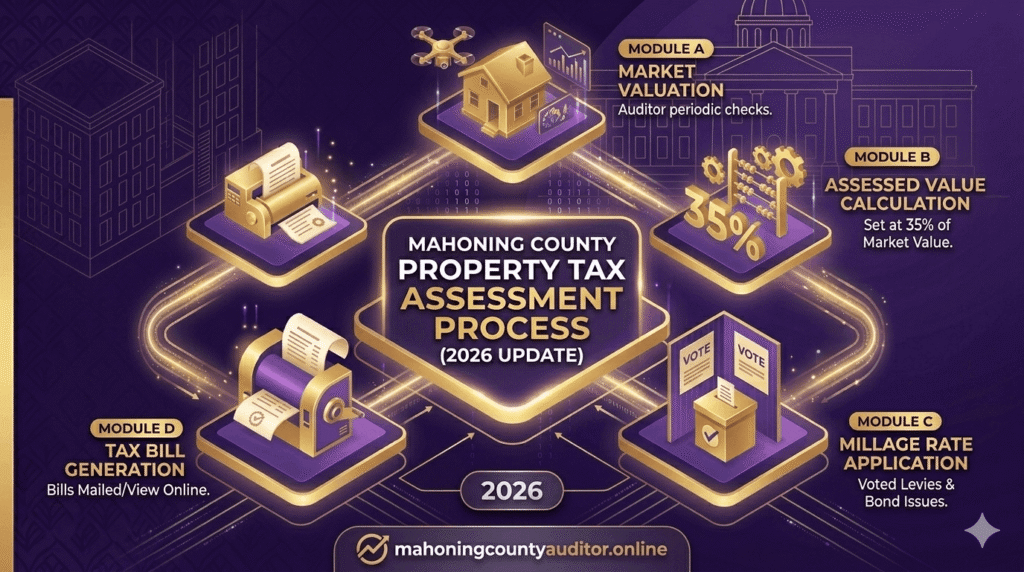
Many residents are confused by how their tax bill is derived. In Ohio, property taxes are not based on the full 100% market value of your home. Instead, they are calculated using the Assessed Value, which is legally set at exactly 35% of the appraised market value.
- Appraised Value: This is the total estimated worth of your property as determined by the County Auditor’s periodic valuations.
- Assessed Value: This is the taxable portion of your home (35% of the Appraised Value).
- Millage Rates: This is the specific tax rate applied to your assessed value. One “mill” represents $1 of tax for every $1,000 of assessed value.
- Effective Tax Rate: Because of various state-wide rollbacks and reduction factors, the actual rate you pay is often lower than the “gross” millage rate voted on in local elections.
The Role of the County Treasurer vs. Auditor
To navigate the Mahoning County Property Tax system effectively, you must understand the two different offices involved:
- The County Auditor: Responsible for valuing your property and maintaining the Mahoning County Tax Map and ownership records. If you believe your property value is too high, you file a complaint with the Auditor’s Board of Revision.
- The County Treasurer: Responsible for the collection of taxes. Once the Auditor sets the value, the Treasurer sends out the bills and processes the payments.
Important Tax Deadlines for 2026
Timeliness is the most critical factor in managing your property taxes. In Mahoning County, missing a deadline results in an automatic 10% penalty on the unpaid balance. Generally, tax bills are issued in two installments:
- First Half Due Date: Typically falls in mid-to-late February.
- Second Half Due Date: Typically falls in mid-to-late July.
If you have a mortgage, your taxes are likely paid via an escrow account. However, it remains the homeowner’s responsibility to ensure the bank has made the payment on time. If you have not received a bill by late January or early June, you should contact the Treasurer’s office immediately.
How to Pay Your Property Taxes Online
The Mahoning County Treasurer provides a secure online portal for payments, which is the preferred method for most residents in 2026. You can securely process your payments and view current billing cycles via the official Mahoning County Treasurer website.
- eCheck (Electronic Check): This is often the most cost-effective digital method, usually carrying a small flat processing fee.
- Credit/Debit Cards: While convenient, these payments typically include a percentage-based “convenience fee” charged by the third-party processor.
- ACH Auto-Pay: You can enroll in a program where your tax payment is automatically deducted from your bank account on the due date, ensuring you never face a late penalty.
Programs to Reduce Your Tax Burden
Ohio law provides several avenues for tax relief that can significantly lower your Mahoning County Property Tax bill:
- The Homestead Exemption: This program allows low-income seniors (aged 65 or older) and permanently disabled individuals to shield up to $26,200 of their home’s market value from local property taxes.
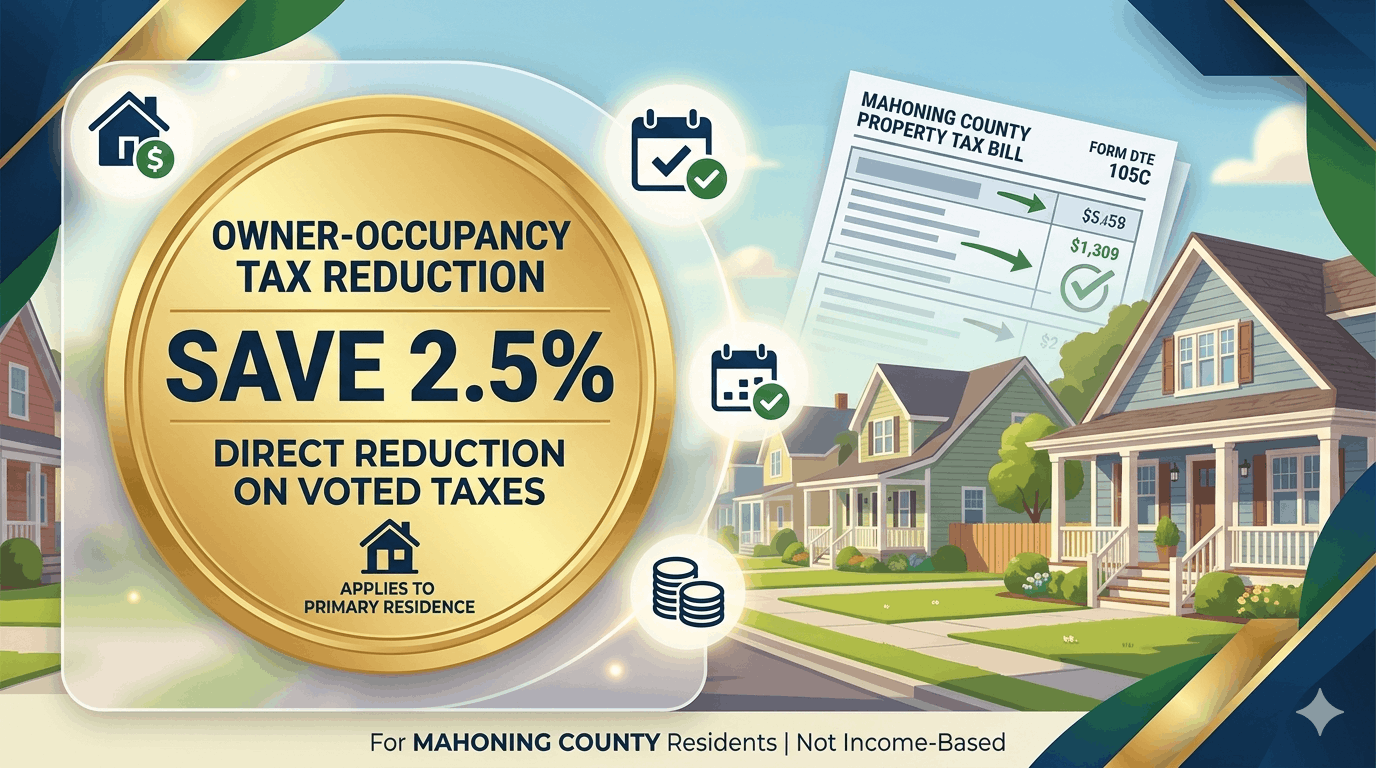
- Owner-Occupancy Credit: If you live in the home as your primary residence, you are eligible for a 2.5% tax reduction. You must apply for this through the Auditor’s office.
- CAUV (Current Agricultural Use Value): This is a major tax savings for land used exclusively for commercial agriculture, valuing the land based on its crop production potential rather than its development value.
Understanding Delinquent Taxes and Foreclosure
When property taxes go unpaid, they become “delinquent.” Delinquent taxes stay attached to the property even if it is sold. If taxes remain unpaid for an extended period, the county may initiate a tax foreclosure, leading to a Sheriff Sale.
- Payment Plans: If you are struggling to pay, the Treasurer offers “Delinquent Tax Installment Plans” which allow you to pay off back taxes over time to avoid foreclosure.
- Tax Liens: In some cases, the county may sell tax lien certificates to private investors, who then have the right to collect the debt plus high interest.
Table: Common Property Tax Terms
| Term | Definition |
| Market Value | The estimated price the property would sell for on the open market. |
| Assessed Value | The taxable value of the property (35% of Market Value). |
| Millage Rate | The rate of tax per $1,000 of assessed value. |
| Special Assessment | A fee added for local improvements like sewers or lighting. |
| Escrow | An account held by your bank to pay taxes on your behalf. |
Conclusion
Staying on top of your Mahoning County Property Tax is essential for maintaining your home’s equity and supporting your local community. By understanding the calculation methods, utilizing available exemptions like the Homestead credit, and respecting the semi-annual deadlines, you can manage your tax obligations with confidence. For detailed maps of your taxable parcels, be sure to visit our Mahoning County Tax Map guide to see exactly how your land boundaries are recorded.
FAQs
Why did my property taxes go up when my house didn’t change?
Taxes can increase for two reasons: a “Triennial Update” or “Sexennial Revaluation” by the Auditor, or a new local school or emergency levy passing in your specific district.
Where can I pay my taxes in person?
You can visit the Mahoning County Courthouse at 120 Market St, Youngstown, OH. There is also a secure drop-box available for after-hours payments.
Can I appeal my property’s value?
Yes. You can file a “Complaint Against the Valuation of Real Property” with the Board of Revision between January 1st and March 31st each year.