Mahoning County property owners often notice additional charges on their tax bills that go beyond the standard property tax rate. These are known as Special Assessments and Local Levies. While they both contribute to community development, they function very differently in how they are calculated and what they fund. This comprehensive guide explores the mechanics of these charges in Youngstown and surrounding areas for the 2026 tax year.
What are Special Assessments in Mahoning County?
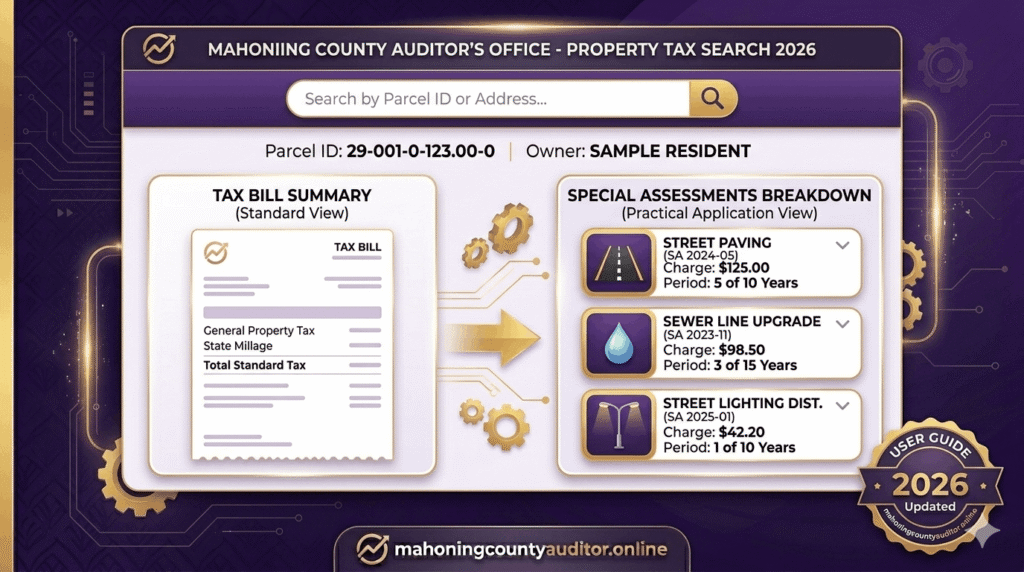
A special assessment is a charge imposed by a government authority on specific properties to pay for a public improvement that provides a direct benefit to those specific parcels. Unlike general property taxes, which are based on the value of your home (ad valorem), special assessments are typically based on the cost of the project and how much your property benefits.
Common Examples of Special Assessments:
- Street Paving and Curbing: If your township decides to repave your specific street, the cost may be split among the homeowners on that road.
- Water and Sewer Line Extensions: Connecting a neighborhood to the municipal water system often involves a multi-year special assessment.
- Lighting Districts: Specific neighborhoods may vote for additional street lighting, funded by a dedicated assessment on their tax bills.
- Sidewalk Repairs: In many Ohio jurisdictions, maintaining the sidewalk in front of a home is the owner’s responsibility, sometimes funded via an assessment if the city performs the work.
The Role of Local Levies (Voted Taxes)
While assessments are project-specific, Local Levies are taxes voted on by the public to fund broader community services. In Mahoning County, these levies are a critical part of the funding structure for schools, libraries, and emergency services.
1. School Levies
The largest portion of your tax bill usually goes to your local school district. These levies are often divided into “Operating Levies” (for daily expenses like teacher salaries) and “Bond Issues” (for building new schools).
2. Emergency Service Levies
This funds the police and fire departments in townships like Austintown, Boardman, and Canfield. These are essential for maintaining 24/7 protection and purchasing modern life-saving equipment.
3. Human Services & Parks
Mahoning County also has county-wide levies that support the Board of Developmental Disabilities, Children Services, and the Mill Creek MetroParks system.
How Assessments and Levies Affect Your 2026 Tax Bill
For the 2026 tax cycle, Mahoning County residents should be aware of how these charges are calculated.
The 35% Assessment Rate
In Ohio, property is taxed at 35% of its appraised market value. For example, if the Mahoning County Auditor appraises your home at $100,000, your “taxable value” is $35,000. Your levies are then applied to this $35,000 figure.
Special Assessment Collection
Understanding Mahoning County Special Assessments and local levies is essential for every property owner in 2026. These additional charges go beyond standard tax rates . The annual amount is added to your first and second-half tax bills. It is important to note that these assessments are attached to the land, not the owner. If you buy a property in Youngstown that has an active assessment for a new sewer line, you become responsible for the remaining payments.
Important Deadlines and Payment Information
To avoid late fees and penalties (which can reach 10%), Mahoning County owners must adhere to the official schedule:
- First Half Due Date: Typically mid-February.
- Second Half Due Date: Typically mid-July.
Payments can be made online through the official Mahoning County Treasurer portal, which we recommend for secure and fast processing.
Can You Challenge an Assessment or Levy?
While you cannot “challenge” a levy that was passed by a majority vote of the people, you can inquire about special assessments. If you believe your property was incorrectly included in an assessment district (for example, if you are being charged for a sidewalk that doesn’t exist), you should contact the Mahoning County Auditor’s Office.
For challenges regarding your property’s valuation which directly affects how much you pay for levies you must file a complaint with the Board of Revision (BOR) between January 1st and March 31st.
Summary Table: Levies vs. Special Assessments
| Feature | Local Levies | Special Assessments |
| Purpose | General community services (Schools, Police) | Specific local improvements (Sewer, Paving) |
| How it’s passed | Public Vote (Ballot) | Legislative action or neighborhood petition |
| Calculation | Based on Property Value (Millage) | Based on project cost/benefit to property |
| Duration | Can be permanent or for a set term | Ends once the project cost is paid off |
How to Read Your Special Assessment Breakdown
Conclusion
Understanding the “extra” lines on your Mahoning County tax bill is essential for every homeowner. Whether it is a school levy funding the next generation or a special assessment improving your street’s infrastructure, these funds are the backbone of local development.
For more help navigating your property records, check out our Mahoning County Tax Map guide to see exactly where your parcel boundaries lie.
FAQs
Levy vs. Special Assessment?
A Levy funds community services (schools/police) based on property value. A Special Assessment only charges specific properties for localized projects (like new sewers).
How long is the payment period?
Assessments are typically spread over 5 to 20 years. Once the project cost is fully paid, the charge is removed from your tax bill.
Does it transfer to the new owner
Yes. Assessments are attached to the land (parcel). If you sell the home, the buyer becomes responsible for any remaining installments.
Do citizens vote on assessments?
No. Unlike levies which require a public vote, assessments are usually approved by local council action or neighborhood petitions.
Where can I check my records?
You can find assessment details on your annual tax bill or by searching your parcel on the official Mahoning County Auditor website.